Supported targets
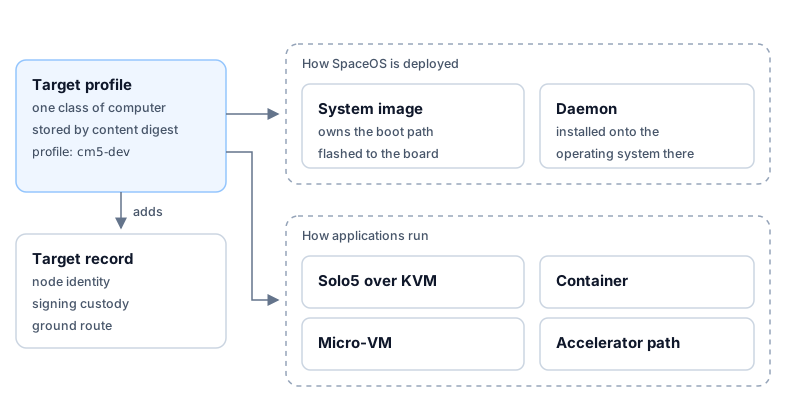
A target profile records the facts needed to assemble and run a release on one class of computer. The target record adds the node identity, signing key, and ground route.
space embeds the catalog snapshot released with the CLI, and
space target catalog sync updates a managed checkout of it from the public
parsimoni-labs/targets repository. A project can carry a profile under profiles/; that project profile takes
precedence over the managed and embedded catalogs. Every connection stores the
resolved profile’s exact content digest.
Two scales, and they answer different questions
A target is described on two independent axes, and a board needs both.
How SpaceOS is deployed. Either it is the operating system, assembled as a flashable or bootable image and owning the boot path, or it is a daemon set installed onto an operating system the board’s vendor ships.
How applications run. A service runs under an isolation backend: a
container under runc, or a unikernel under a Solo5 tender, Firecracker, or
QEMU. Which backends a target offers is a fact of its profile, and
Substrates gives the matrix.
Target matrix
| Target | Architecture | Integration | Isolation backends | Ready today |
|---|---|---|---|---|
| Development VM (macOS on Apple silicon) | arm64 | System image on the host VMM | runc | Yes |
| Raspberry Pi CM5 | arm64 | System image, flashed | hvt, runc | Yes |
| Hosted Linux | arm64 | Daemon | runc | Yes |
| Provider instance (Scaleway) | arm64 | System image, UEFI | runc | Yes |
| Xilinx VCK190 | arm64 | Daemon | qemu, firecracker, hvt | WIP demonstrated, accelerated |
| NVIDIA Jetson TX2i | arm64 | Daemon | qemu, firecracker, hvt | WIP demonstrated, accelerated |
| NXP LX2160A | arm64 | Daemon | qemu, firecracker, hvt | WIP demonstrated, minimal |
| Raspberry Pi 4B | arm64 | Daemon | qemu, firecracker, hvt | WIP demonstrated, minimal |
| Kalray Coolidge V1 | amd64 | Daemon | qemu, hvt | WIP demonstrated, minimal |
| Innoflight CFC-400XS | arm64 | Daemon | Xen | WIP planned |
Ready today: four targets
Four profiles ship in the catalog. Each names the exact boot contract, runtime backends, and ceilings that a connection pins by digest, and each is something you can connect and deploy to now.
- Development VM. A macOS host on Apple silicon boots the system image
through Apple’s Virtualization.framework. This is what
space runuses, and the profile admitsruncworkloads. - Raspberry Pi CM5. SpaceOS is assembled as a flashable image with the Raspberry Pi firmware partition first, verified by the board’s own signed boot and a command-line-pinned dm-verity root. Two profiles ship: a bench profile with reversible signature enrolment, and a locked profile that requires OTP enrolment and a discrete TPM.
- Hosted Linux. Any operator-owned host with cgroup v2 and systemd v229 or newer. The signed daemon bundle installs under a prefix, the host keeps its own trust boundary, and nothing is flashed.
- Provider instance. An arm64 cloud instance booting UEFI from a block volume created from an imported, content-addressed image. The provider’s hypervisor is the boot trust anchor.
WIP five demonstrated boards
SpaceOS has run on five further boards on a test bench. No profile ships for
any of them, so space target connect resolves none of them by name today and
deploying to one is bring-up work. They are listed because each is a target the
platform is being built toward. The grade below records what has run on the
bench.
Each is graded on the four-level scale the platform’s hardware evaluation uses:
- None, the combination has not been tested or does not work.
- Prototype, unikernels run in static partitions with CPU and memory isolation and at least serial access. There is no dynamic orchestration and no access to storage or acceleration.
- Minimal, the local orchestrator schedules unikernels dynamically and talks to ground software over the network. Unikernels reach local storage, downlink data, and request input from the local manager.
- Accelerated, the same, and unikernels also drive an on-board GPU or FPGA without interfering with each other. A board with no accelerator tops out at minimal, so accelerated on this page always means a device was in use.
What each board reached:
- Xilinx VCK190. Accelerated under
qemuandfirecracker, minimal underhvt. FPGA work runs through the board’s own acceleration API, delegated from the unikernel to the host. - NVIDIA Jetson TX2i. Accelerated under
qemuandfirecracker, minimal underhvt. Unikernels made full use of the on-board GPU. - NXP LX2160A. Minimal under every isolation platform tried, including Xen with Linux as dom0. The board carries no accelerator, so minimal is its ceiling.
- Raspberry Pi 4B. Minimal under every isolation platform tried, including Xen. It is also the board where a seL4 prototype ran: unikernels partitioned by the microkernel with serial access only and no Linux involved.
- Kalray Coolidge V1. Minimal under
qemuandhvt. Acceleration through the board’s OpenCL path is in progress.
WIP one planned board
- Innoflight CFC-400XS. SpaceOS is planned as a daemon set on the board’s stock distribution, with Xen as the tenant isolation. Neither the Xen boot path nor the Xen runner backend exists yet, so nothing on this board runs today.
Connect an existing target
Create targets/cm5-demo.yaml:
schema: space.targetversion: "1"profile: cm5-devconnection: signing_key: keys/cm5-demo.pem endpoint: ipn:7.1 cla_address: cm5-demo.local:4556 always_reachable: trueThe profile names the computer class. The connection section holds this
node’s key custody and the route that carries its releases.
$ space target connect cm5-demoGenerated acknowledgement key: /tmp/space-docs/config/keys/target-cm5-demo-ack.pemtarget/cm5-demo connected$ space target ls NAME PROFILE BOARD ENDPOINT CONTACT cm5-demo cm5-dev raspberrypi-cm5 ipn:7.1 always$ space target show cm5-demoname : cm5-democontext : localprofile : cm5-dev@sha256:...board : raspberrypi-cm5signing-key : keys/cm5-demo.pemdtb : (firmware stock)kernel : (composition default)state-key : (none: unauthenticated boot-state)ack-key : /tmp/space-docs/config/keys/target-cm5-demo-ack.pemrecipient-key: (none: whole-bundle delivery only)recipient-id : (none)endpoint : ipn:7.1cla-address : cm5-demo.local:4556contact : always (a node on a network)rate : 1e+06 B/s (default)The RSA key signs the CM5 boot image, which is the signature the Raspberry Pi
firmware verifies. The generated Ed25519 key authenticates deployment
acknowledgements from this node. In production, set ack_key to a
key-management system path. When it is left out, the CLI generates a local
bring-up key.
A target reached over scheduled contacts needs --tle with --station, or a
fixed --contact-start and --contact-stop.
space target connect records a provider VM, Linux host, edge computer, or
satellite that is already up. It binds the resource to an exact target profile,
identity, signing custody, and transport. It allocates nothing.
Use space target apply when Space should
create or reconcile the resource and connect it in one operation. It acts by
default; --plan prints the plan and stops.
Inspect connected targets
The session above runs space target ls for the targets connected to the
current context, then space target show cm5-demo for the profile and
node-specific settings a deploy resolves. space target ls marks the target a
command with no --target acts on.
space target show prints the registry record for every target. It also prints
what the provider holds against that spec for a target whose manifest declares
provision: resources. That half covers the server, the routed IP,
the data volume, the security group, the registry namespace, and any
outstanding plan. Without provider credentials it reports the provider half
unavailable. A bench board has no provider half at all.
space deploy --plan copies the resolved facts into the release descriptor.
--target is optional. It defaults to the single target declared in
targets/, else the single target connected to the current context.